It would seem that after a show fails on Broadway and loses its entire
capitalization, people would not be clamoring for the rights to mount it
again anywhere else. Particularly since Trevor Nunn's contract
stipulated that he must be offered the job of director in any production
staged in North Amerca and Richard Nelson's contract mandated that his
book MUST be used. No one could do the London version in the U.S.
or Canada.
But many producers and directors had loved the show in London and even
those who had just seen the Broadway version thought it could be
fixed.
Though it opened shortly after the premiere of the U.S. Tour, the highly
respected Marriott Lincolnshire Theatre's Chess really came
first. It was originally conceived as the first stop on the American
Tour. But the Marriott has arena staging, and the tour producer wanted a
proscenium version. Kary Walker, Dyanne Earley and Peter Grigsby, with
director David H. Bell and their design team, had produced dozens of
successful and critically-acclaimed shows in the prior ten years. They
knew they wanted to do Chess as soon as they saw it in
London.
But, according to Grigsby, "Everyone has very violent opinions about
this show." They were also saddled with the Nelson book which they
first believed was sacrosanct. They knew they had to re-think the
entire piece while making as few changes as possible. They felt that
making the characters more sympathetic was the key. This was
accomplished by a combination of direction, casting and subtle
rewriting.
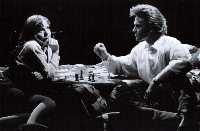
Kim Strauss, cast as Freddie, had the toughest challenge. But he's a
handsome, engaging actor and by softening his scenes with Florence,
making "Pity the Child" a solitary cry for help (instead of placing
it in the context of an interview as had been done in New York),
Strauss and director David H. Bell made the character work.
Susie McMonagle's Florence was played less as an angry, confused
woman and more as a contemporary, intelligent woman with a streak of
sensuality very close to the surface. Bell dropped many hints of her
eventual attraction to Anatoly, which helped the romance's
credibility.
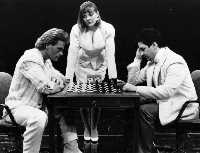
Arena staging--with the playing area in the center and the audience
on all four sides--can be challenging. It allows scenes to be staged
more naturalistically and intimately, but it limits the playing area
and sets. But this team was experienced working with their stage and
knew its limitations as well as its possibilities.
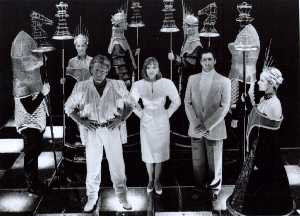
In lieu of elaborate sets, the Marriott team created some extra
"characters" in the form of American and Russian chess
pieces--kings, queens and knights--dressed in stylized Camelot-style
finery. With their elegant black, gold and silver costumes and wire
sculpted chess piece scepters, they became sets themselves as well
as metaphors. Bell used them to propel, comment on, and define the
action.
The illusion of rooms and settings was done with overhead light-grid
ceiling fixtures and sections of the set floor which rose to
simulate beds and tables. The most ingenious use of these platforms
was using a single double bed as half of one room and half of
another, the bed virtually (but not literally) split down the
middle. But the single thing that--more than any other--made
Chicago's Chess work was that they gave Florence back her
father.
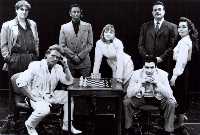
The final reunion of Florence and her father may be schmaltz, but it
had an honest and contemporary feel. All the jokes about
glasnost and perestroika don't do as much as this one
change: in a warmer climate of East/West relations, she probably
would have her father returned to her. All the characters here are
made of sterner, stronger stuff than in previous versions, and
helping bring about the Vassy family reunion is a final act of love
on Anatoly's part and thus he returns home a victor, not the
vanquished.
Clearly, the Marriott Chess benefited from the collaborative
approach. The producers, director and design team all helped rewrite
and rethink the piece, and it showed. There was no aspect of the
performance which was out of place or in contradiction of mood or
style with any other aspect. And they made it appeal to a wide range
of people. Walker said, "We were worried about our weekday matinee
audiences who dislike loud, rock scores. But by giving Florence back
her father, they forgave us everything."
The word went out that the Lincolnshire Chess was a hit. A
State Department-sponsored tour of theatre producers from all over
the world visited this Chess in its Chicago suburb; many
regional theatre producers flew in to see it and planned productions
in their own houses in 1991. Tim Rice was extremely impressed with
their work and said he was encouraged that they'd made it work so
well. He particularly liked the way the dual bedroom scenes
connected all the characters. It closed after a $1-million-plus
sold-out limited engagement.