LONDON (1978)
Cut to Prince's New York office, 1976, where Rice and Lloyd Webber stood, hats and record in hand. The
album was good, they wanted him to stage Evita and Prince said yes, but he wouldn't be free until
1978. Tim and Andrew decided Prince was worth it and they'd wait.
In the next year, the Evita concept album became a worldwide hit, selling two million copies. Tim
and Andrew had no trouble this time raising money for the stage production. Prince says the album's
success caused problems: "All those people who listened to the concept album have a production of Evita
in their heads. But I'm not in their heads, I'm in mine. It's an interesting problem because you have to
satisfy some expectations, yet surprise them."
Julie Covington, who sang the role of Eva Perón on the concept album, was offered the lead on the stage.
Rice remembers: "Julie Covington is a strange girl in that she doesn't want to be successful. In that,
she's been very successful. She turned down the part on the legitimate stage. She's a respected actress
in England but seems to be happiest doing very obscure and often very political plays."
C.T. Wilkinson, the concept album's Che, was a rock singer with a steady recording and tour career.
Though he had been in Superstar, he wasn't enamored of the musical stage either--at least not
until ten years later when he began to use his first name, Colm, and created a sensation as the first
Jean Valjean in the musical, Les Miserables.
There was a "world-wide casting call" for an unknown to play Eva Perón that was publicized as if it was
the search for Scarlett O'Hara, but Prince, Rice and Lloyd Webber eventually chose Elaine Paige, a tiny
bundle of energy with a giant voice. She had played small roles in Superstar, Billy (with
Michael Crawford), Grease and Hair. David Essex, who was given first billing, had played
Jesus in Godspell, but was best-known for his recording and concert work, as well as his own TV
show. To round out the triumvirate, highly respected classical actor Joss Ackland would play Juan
Perón.
Prince worked with the authors to make the transition from record studio to stage. He had the music
re-orchestrated to make it more of a musical theatre style and to remove the more blatant rock elements
which would date the piece. There were small changes throughout, and one song was deleted, "The Lady's
Got Potential," which was all about Che inventing an insecticide (!)and Perón learning to ski in
Italy:
Just one blast and insects fall like flies!
Kapow! Die!
They don't have a chance
In the fly-killing world
It's a major advance
In my world
It'll mean finance
I'm shaping up successful capitalist-wise
Kapow! Die!
They don't have a chance
In the fly-killing world
It's a major advance
In my world
It'll mean finance
I'm shaping up successful capitalist-wise
There were other references to Che and his bug-spray elsewhere in the show:
I have a product to change your conception of man
A brand new insecticide a remarkable chemical feat
Instantly rendering other insecticides obsolete
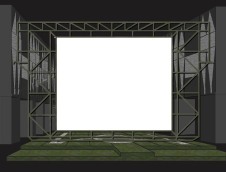
Prince hired Timothy O'Brien and Tazeena Firth to design the show. After their first meeting with Prince in 1977, they didn't know where to begin. "We went away from that meeting in Majorca saying 'How on earth are we going to do justice to this piece?' It seems so simple now--but then we had two records. That's all."
 |
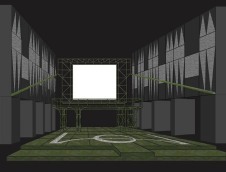 |
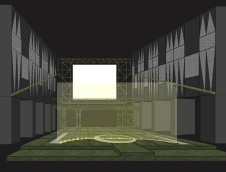
They also decided on a raked stage for a more effective presentation of the actors. Into it, they embedded a circle, a larger semi-circle and two parallel lines of light. Hal Prince described them to the company on the first day of rehearsals in London: "There is a semi-circle here, which is a light curtain. Sometimes there will be nothing on the stage but performers and that light curtain. If you step through it, you come from nowhere. If you step through it the other way, you disappear before the audience's eyes."
As noted above, Prince wanted Che specifically identifiable as the revolutionary Guevara. To explain his presence in Evita, Rice added a verse to Che's opening song:
His head held high while millions weep
Why the exception to the rule?
Opportunist, traitor, fool?
Or just a man who grew and saw
From seventeen to twenty-four
His country bled and crucified
She's not the only one who's died!
Best remembered for his vital part in Castro's takeover and initial administration of Cuba, Guevara became a legend when he was killed while fighting in Bolivia in 1967. Born to radicals of aristocratic heritage in Rosario in 1928, Che enrolled in medical school at the University of Buenos Aires in 1947. Though there were many student anti-peronista groups, he seems not to have participated in any of them.
People's lives rarely provide the suspense of original drama, and Che's presence in Evita contributes that sort of suspense. The actual opposition to the Peróns came from many splintered factions and was often lacking articulation and leadership. When a leader emerged who showed signs of developing a following, he was quickly deported to Uruguay.
The British press greeted Evita's theatrical launching with such hysteria that it nearly forced the production team into seclusion. The staid Sunday Times put Elaine Paige on the cover of their color magazine in a replica of the Argentine stamps bearing Eva's profile. Dewynters, the undisputed top theatrical design firm, created a memorable logo by superimposing Eva's head on the Argentine flag.
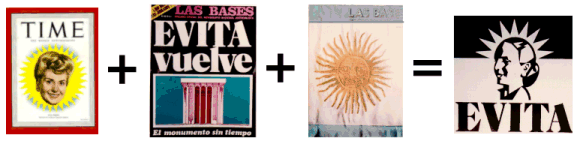
It's hard to remember that Evita was the first show to create such avid anticipation long before opening night. Now that Cameron Mackintosh has honed and refined this art of orchestrated hype for shows such as Les Miserables, Miss Saigon, The Phantom of the Opera and Cats, it's become the standard.
Nothing about Evita happened quietly. This was partly due to its controversial subject, but mostly because Robert Stigwood, who produced Evita with his theatrically savvy associate David Land, already had a massive publicity machine in place, used for his promotion of rock groups like the BeeGees who were under contract to his RSO Records. When Evita opened at the Prince Edward Theatre, it was reviewed as far away as Singapore, India and Sweden.
"After the ludicrous ballyhoo, there was a danger the show itself would be an anti-climax," The Guardian's Michael Billington said after Evita's premiere on July 21, 1978. "But the first thing to be said about Evita is that it is an audacious and fascinating musical."
"Evita is a superb musical, but its heart is rotten. It is a glittering homage to a monster," huffed critic John Peter in The Times. "I never cease to marvel at the sentimental fascination English people feel for political cannibals. Watching Evita is, in some ways, like looking at shop-windows selling Nazi uniforms and Japanese bayonets; they seem to cast a baleful spell on the curious innocents who never saw them in action."
Rice's contribution was generally discussed more in terms of the "book" [Rice insists there is no book, though he won a Tony Award for it] or idea, rather than his lyrics. The Times's music critic, Derek Jewell, knew the difference. "Everything is sung in Evita. No lumbering book links it, but elegant and powerful recitative which continually points up character... practically every word of Rice's can be instantly savored by the audience ....in Tim Rice, Andrew has a partner of perfection. Rice writes trenchant, modern lyrics, superbly married to Lloyd Webber's ambitious score."
The Times' critic Bernard Levin incites Rice's wrath to this day: "Bernard Levin accused us of bringing about the downfall of the century. He thought we were responsible single-handedly--or double-handedly--for the decline of civilization since about 1945, which I think was a little over the top. Evita isn't a perfect work, but I think his criticism was a little heavy. [Rice got his revenge during his speech at the Prince Edward on Evita's closing night a long seven years later. His final remark was "Bernard Levin, f---- you!"] You tend to get much worse reviews if you have a hit. You either get raves or absolutely dire reviews. With Evita we've had both."
Oddly enough, it seems that on later reflection, most critics revised their opinions of the show and the quality of Tim's lyrics. Critics in London, Los Angeles and New York all voted for Evita for various awards, despite having panned the show just a few months earlier. Frank Rich, the longtime New York Times theatre critic and dreaded "Butcher of Broadway," had quite a change of heart about Evita over the years. Reviewing the London premiere, Rich said: "Evita's London success far outstrips the show's merits...[it] is a cold and uninvolving show that does little to expand the traditional musical comedy format or our understanding of a bizarre historical figure...we have no idea how to judge her; to Rice, fascism seems to be more a cultural style than a political ideology...if Rice were a dazzling writer, such silliness might be tolerable, but his lyrics rarely rise above the cute. The show's structure is clumsy."
By 1988, Rich had mellowed considerably: "Throughout his career [Andrew Lloyd Webber] has been held hostage by his lyricists. If a composer is working with unsophisticated lyrics, he's in trouble. The most sophisticated lyricist, in my view of Lloyd Webber's career, has been Tim Rice. While Evita may in some ways be a naive and simplistic historical view of the Peróns, as show business lyric writing, Rice's work is very clever and I think Lloyd Webber responded with a more interesting and varied score than usual."
In later books on musical theatre, Rice is usually lauded, particularly for his work on Evita. Sheridan Morley cited two lyrics:
Since 17 October 1945
and:
So Christian Dior me
With that image, Elaine Paige became an instant star after opening night. The praise was unanimous: "Elaine Paige's transformation in the role is one of the rewards of the evening: starting as a dumpy, mouse-haired little scold, acquiring the sumptuously voluptuous looks of a pampered courtesan...she handles the changes with shocking immediacy, and her voice fills the theatre like a whole brass section; most expressive of all is the extent to which she shows Evita becoming totally captivated by her own dream, " said Irving Wardle of The Times. Other headlines summed up: "Don't cry for Elaine, she's an instant superstar;" "Little Elaine, you're great;" "Elaine takes town by storm;" and "A star is born."

This commentary is actually continuous, though relevant parts have been placed under each production's section. To read the entire commentary straight through, use the buttons below:
 |
 |
This material is strictly the opinion of the author
of this website.
© 2000