Commentary
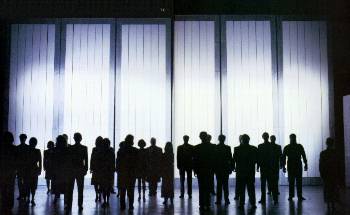
London's Chess was still selling out as everyone prepared for
Broadway. Even had it been
perfect, the Prince Edward Chess could not be duplicated in New
York; it would have cost more than
$15 million to replicate the sets, costumes and staging. It's also
unlikely Trevor Nunn would have agreed
to duplicate his London work--he wanted to do his very own Chess
from scratch. Tim Rice was
optimistic, "Trevor Nunn will, of course, still direct which is
good news." Rice proceeded with the rewrites.
"I am making some fairly hefty alterations to the storyline (for
example the first half of the show now takes
place in Bangkok, the second in Budapest) and we aim to include at least
two new songs. Very few of the
current songs will be booted out--the changes are primarily with the
bits in between, which will include a
good deal more dialogue. In this way, we hope to make the plot clearer
and the character of Freddie, in
particular, more rounded. At the moment he fades out in Act
2."
Everything had to wait for Nunn, who had prior commitments to direct
both Les Miserables and
Starlight Express in New York. Nunn finally gave the producers a
small window before and after
which he would be unavailable.
Rice sent his revised script to Nunn and the Shuberts' Bernie Jacobs
long before their first New York
meetings but had had no response from anyone. During the first casting
sessions in New York, no one
mentioned the rewrites. Still, Rice had no reason to worry, and was not
in the habit of making waves.
Yet the casting sessions should have given him a hint. Trevor spent a
great deal of time seeing actresses
to play Florence, though Tim thought Elaine Paige was set to reprise her
London triumph.
Rice also knew that Richard Nelson--an avant garde political
playwright--had been asked to "present some
ideas." It wasn't until Bernie Jacobs, Trevor Nunn and Robert Fox were
rushing for planes to three continents
that Rice was bluntly informed that Nelson's script had been completed
and accepted. No comment was
ever made on his own rewrite (which would eventually triumph in Sydney
several years later).
Politics were in evidence both on and off the stage. Nunn was determined
to have Florence not only be an
American in this version, he wanted her played by one. Laurie Beechman
(who starred in Rice's Joseph
and the Amazing Technicolor Dreamcoat) and Judy Kuhn (New York's
original Cosette in Les
Miserables) were Nunn's favorites. But what about
Elaine?
American Actors Equity was still bruised from its most recent
Anglo-American confrontation. Andrew Lloyd
Webber had threatened to pull Phantom from Broadway (and put 125
union members out of work) if
they didn't allow his wife Sarah Brightman to play the role he had
written for her. Hal Prince led an eventually
successful campaign backing Lloyd Webber and Brightman.
Rice had, of course, written Florence for Elaine Paige and she was a
much more well-known star than Brightman.
Tim said that some time before this "Bernie Jacobs assured me there
would be no problem" getting Elaine over.
Yet a member of the Equity Committee quotes Bernie Jacobs at one of
their meetings, "If anyone's coming, it's
the Swede [Tommy Körberg]." Nunn offered no support and Rice
withdrew Elaine's application.
The show was new from top to bottom. A new logo replaced the esoteric
but elegant fractured chessboard of
London. It de-emphasized the game, highlighted the political context and
looked vaguely like the cover on a
1960s-vintage spy novel. The cast had only a few dancers and there was
little choreography. Nunn had Robin
Wagner design a turntable very like the one in Les Miz and a
dozen radio-controlled triangular concrete-faced
towers that moved; six of them were as high as the proscenium arch.
These towers were grim in the extreme.
They resembled nothing so much as penitentiary walls and there were
perilous moments at previews as the
operators inside them lost control and one nearly fell into the
orchestra pit. Throughout the run, audience
members in the first 10 rows could hear the men inside them speaking
into their headsets as they lost
orientation.
Opening in April 1988, Chess was no longer nearly through-sung. It was
now a show with songs. And it no longer
looked vibrant and interesting. The mood for the whole show was cold.
Oddly, despite the
abstract towers forming and re-forming as vague indications of hotel
rooms, parking garages and the grim
streets of Eastern Europe, Nunn used realistic sound effects including
traffic noises, elevator bells and dogs
barking. The costumes were dark and drab, as was the physical look of
the company--there was only one blonde.
The brightness and levity of Merano and the British Embassy were gone,
as was the color and variety of the
video screens.
The story was marginally clearer but even more complicated. Plus, the
three principal characters were unlikable.
The warming of the Cold War rested uneasily on the plot, particularly
co-existing with the anachronisms of the
punishment exacted on Anatoly's family, his KGB guards and the notion of
exchanging spies. The Arbiter was
played as a macho Greek (to imply Greek Chorus?!) and seemed completely
extraneous (he became even more
so when the "Arbiter's Song" was cut after opening night). The
scenes between
Florence and her father were shamelessly manipulative and the final
outcome unbelievable since he was easily
recognizable as the same actor from the prologue. Freddie's screaming
and filthy, vicious cracks about
Florence and Anatoly, Florence's groveling and Anatoly's
weakness were problems even the strong performers couldn't
overcome.
Despite this, Chess succeeded on several levels. The splendid new
orchestrations by Anders Eljas made
the music more timeless and theatrical, and the actors were flawless.
Judy Kuhn literally stopped the show with
"Nobody's Side" and a beautiful new song, "Someone Else's
Story." David Carroll brought a different but no
less powerful thrill to "Anthem," and the energetic Philip
Casnoff gave Freddie what heart he could. Harry Goz
and Dennis Parlato took Molokov and Walter beyond stereotypes and were
the only comic relief.
The new songs were all good and blended seamlessly with the old. A wry,
funny duet for Walter and Molokov
(unfortunately not included on the American cast recording) was a nearly
unrecognizable version of the "One
Night in Bangkok" music, cleverly done up as a tango.
"Apukad" used music from "You and I,"
while the Hungarian Folk Song was set to the music from Walter's theme
in London.
But the biggest loss was London's incidental music--phrases used for
occasional lines in the brief bits of actual
dialogue and background music for every other moment of the show.
Ulvaeus and Andersson's beautiful,
emotional underscoring and use of themes for each character was lost, as
was the subtle information imparted
by this kind of music.
Tim Rice had essentially disowned the project before opening night.
Though he had been initially hopeful and
optimistic enough to invest $3 million of his own, he couldn't bear to
watch it any more. "Those characters
mean nothing to me. They aren't the ones I created." Tim's wife
Jane was the only Rice in the audience
opening night. Tim made a brief P.R. appearance at the post-show party
and left early.
The critics despised nearly everything about the show. "Checkered
Musical," "Chess Bored" screamed the
tabloids. The TV critics were worse. They called the opening "A
parody of Les Miz," said the music was
"deafening" and "humdrum," the lyrics
"godawful," the set "Stonehenge on wheels," the
direction "busy," the
story "incoherent" and "commonplace and third-rate."
One thought Freddie was an "utterly and pointlessly
hateful" character and another said Nelson's dialogue "makes
The Guiding Light sound like Sophocles."
Every review was prefaced by "the latest British import" or
"Another British mega-musical."
Some observers thought Nunn wanted to go head-to-head with Hal Prince
(who directed Phantom) in the
Tony Awards--presupposing Nunn could win--but whatever the reason, Nunn
had forced Chess to open
in New York right before the Tony Awards, and on the heels of
Starlight Express, Les Miserables and
The Phantom of the Opera, all from London. The RSC's
Carrie opened one week later, fresh from
English tryouts. Being a British import was a death sentence that
spring.
The only non-British musical hit that season was Anything Goes, a
revival. Had the Americans lost their
touch? Maybe not, but New York was in the middle of a wave of
chauvinistic British-bashing. The heavy
backlash against Andrew Lloyd Webber and Phantom's massive hype
tarred his former partner with the
same brush. Tim Rice was still inexorably linked to Lloyd Webber.
Audiences, however, greeted the show with great enthusiasm and there
were nightly standing ovations and
exceptional word-of-mouth, despite what most agreed was a pretty
repellent second act. Many people felt that
with Chess, Rice had at last stepped out from behind Lloyd
Webber's shadow.
The Tony Award nominating committee pointedly ignored Chess
except for Judy Kuhn and David Carroll.
They, after all, were Americans. The musical and Trevor Nunn were not
even nominated. The Awards snubbed
the Brits where they could--Andrew Lloyd Webber lost the score and book
awards to Stephen Sondheim's
Into the Woods, though Phantom was named Best
Musical.
By the end of May, Chess was breaking even but the lack of Tony
Awards or exposure on the telecast
was a blow. Despite the excellent word-of-mouth, advance sales dwindled.
When the advance for the last
week of June wasn't sufficient to pay expenses, the Shuberts closed the
show. But Chess wouldn't die.
The American cast album sold well and the show headed toward cult
status, not unlike Sondheim's
Merrily We Roll Along--another show with a great score and minor
book problems--which was decimated
by its directorial concept.
On the night of January 9, 1989, Chess was sung in concert at
Carnegie Hall. David Carroll managed to
assemble all but two members of the entire original Broadway
Chess cast for this benefit concert in New
York. The actors paid their own transportation from all over the world.
They came from bus-and-truck
companies of Cats, from national tours, from film locations and
regional theatres, from European
productions of Les Miz. The near sell-out crowd cheered the
opening number with such incredible
enthusiasm that the conductor turned around in shock. Though it was a
benefit concert, the audience wasn't
celebrity-filled or star-studded, simply 2800 people who wanted to hear
Chess. It was proof that the score--unencumbered
by any dialogue--was solid gold.


| | |